
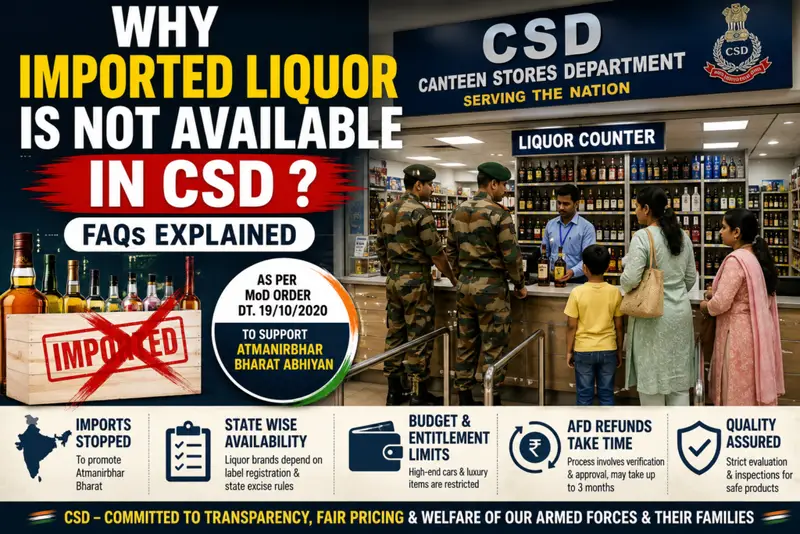
The Canteen Stores Department (CSD) is one of the largest retail supply organizations serving Armed Forces personnel, Ex-Servicemen, Defence Civilians, and their families. While lakhs of beneficiaries use CSD facilities every month, many questions continue to arise regarding liquor availability, imported products, AFD purchases, refunds, URC operations, supplier policies, and pricing.
To help beneficiaries better understand the system, here is a detailed explanation of the most frequently asked questions based on official CSD guidelines.
Why Imported Liquor Is No Longer Available in CSD?
One of the most common questions from beneficiaries is regarding the disappearance of imported liquor brands from CSD shelves.
Official Reason
As per the Ministry of Defence order dated 19 October 2020, procurement of directly imported products through CSD was discontinued to support the Government’s Atmanirbhar Bharat Abhiyan initiative.
Therefore, imported liquor and other directly imported items are no longer being procured by CSD.
Why Is a Liquor Brand Available in One City but Not Another?
Many beneficiaries notice that a particular whisky, rum, vodka, or beer is available in one state but unavailable in another.
The Reason
Liquor availability depends upon:
State Excise Policies
Label Registration by Distilleries
State-wise approvals
For example, a liquor brand available in Bareilly (Uttar Pradesh) may not be available in Ranikhet (Uttarakhand) because registrations are different in each state.
Therefore, liquor availability varies from state to state.
Why Has CSD Stopped Imported Goods?
The reason remains the same:
MoD Order dated 19 October 2020
Promotion of domestic manufacturing
Support to Atmanirbhar Bharat
As a result, direct imports have been discontinued across CSD.
Why Can’t Eligible Personnel Purchase Very Expensive Cars Through CSD?
Many beneficiaries ask:
“I am paying for the vehicle from my own pocket. Why can’t I buy a luxury or high-end car through CSD?”
Official Explanation
CSD operates within a budget allocated annually by the Ministry of Defence.
To ensure equitable distribution of resources:
Rank-wise purchase ceilings are prescribed.
Vehicle eligibility is controlled by authorized price limits.
Luxury vehicles beyond prescribed limits are not included.
Hence, even if a beneficiary can afford a higher-end vehicle, purchases must remain within the entitlement limits approved by the authorities.
Can Troop Rations and ACG Items Be Purchased Through CSD?
No. Institutional purchases such as:
Troop ration items
Army consumption goods (ACG)
Government-funded supplies
are procured through separate government budget channels and are therefore not authorized for purchase through CSD.
Why Was Gin Not Available in CSD for Some Time?
The shortage occurred primarily because of raw material availability issues. However, several gin brands have now been introduced in many depots, including:
Jaisalmer Indian Craft Gin
Greater Than London Dry Gin
Availability may still vary by depot and state.
Why Do URC Shelves Become Empty Before Month-End?
This issue generally arises because: Inaccurate Demand Forecasting. CSD depots supply stores based on the projected demand submitted by Unit Run Canteens (URCs).
If a URC:
Underestimates demand
Submits lower projections
Faces financial constraints
then stock-outs may occur before month-end.
Why Can’t CSD Supply Goods Directly to URCs Like ASC Ration Contractors?
The answer lies in GST regulations. GST Benefits. CSD enjoys:
50% GST exemption on sales
Special GST refund mechanisms
Direct supply arrangements similar to ASC systems would create significant GST complications. Therefore, goods must move through the established CSD distribution system.
Why Don’t CSD Depots Accept Corporate Credit Cards?
CSD accounting regulations require:
Payments only through authorized URC bank accounts.
Daily remittance of receipts into government accounts.
Because of these financial control mechanisms, corporate credit cards are not accepted.
Why Does a URC Sometimes Receive Much Less Stock Than Requested?
A common reason is the difference between:
Provisional Demand (PD)
and
Final Demand (FD)
If the provisional demand submitted is significantly lower than the final requirement, the stock allocation may be insufficient.
Why Are Purchase Limits Imposed on Certain Grocery Items?
Limits are imposed to prevent:
Misuse of subsidized facilities
Unauthorized purchases
Diversion of CSD supplies
These restrictions help ensure that benefits reach only eligible beneficiaries.
Why Do AFD Cancellation Refunds Take So Long?
Many beneficiaries express concern regarding delayed refunds after cancelling an AFD purchase.
Refund Process
The process involves:
- Application submission at nominated URC.
- Forwarding to concerned depot.
- Verification of claim.
- Projection of funds to CSD Headquarters.
- Approval by Competent Financial Authority.
- Release of funds.
How Long Does It Take?
Refunds may take up to three months, depending on fund availability.
Is Interest Payable?
No.
Since the money is deposited into the Consolidated Fund of India, existing government rules do not permit payment of interest on such refunds.
Deletion proceedings may begin.
Show-cause notice may be issued.
Price Revision Rules for Suppliers
A supplier may seek price revision:
One year after product introduction.
Maximum twice annually.
Minimum six-month gap between revisions.
Price increases require justification and evaluation.
Price reductions can be implemented immediately and retrospectively.
- Jharkhand
- Uttar Pradesh
Several other states provide partial tax concessions.
Quality Complaints and After-Sales Service
What Should Beneficiaries Do If a Product Develops Problems?
The first step is to contact:
Manufacturer’s customer care
Authorized service center
just like any civilian consumer.
If unresolved, beneficiaries may:
Approach CSD
File a complaint under consumer protection mechanisms
How Are Food and Liquor Quality Complaints Investigated?
Complaints are examined through:
Food Inspecting Organization (FIO)
Quality testing agencies
FSSAI standards
If defects are confirmed:
Sale may be suspended.
Penalties may be imposed on suppliers.
What If the Warranty Card Is Missing?
Beneficiaries should verify:
Product condition
Warranty card
Guarantee documents
before accepting delivery.
Products requiring warranty coverage should not be accepted without proper documentation.
Frequently Asked Questions (Original FAQ)
Q1. Why are imported liquor brands no longer available in CSD?
Answer: Imported liquor procurement was discontinued following the Ministry of Defence order dated 19 October 2020 to promote the Atmanirbhar Bharat initiative.
Q2. Why is a liquor brand available in one state but unavailable in another?
Answer: Liquor brands require state-specific label registration and excise approvals. Availability varies from state to state.
Q3. Why can’t I buy a luxury car through CSD even if I can afford it?
Answer: Vehicle purchases are governed by entitlement ceilings and budgetary limits approved by the Ministry of Defence.
Q4. Why do AFD refunds take several months?
Answer: Refunds require multiple stages of verification and financial approval, and may take up to three months.
Q5. Can ex-servicemen buy cars through CSD?
Answer: Yes, subject to the applicable entitlement rules and eligibility conditions.
Q6. How often can I buy a television or refrigerator through CSD?
Answer: Generally once every three years, subject to prevailing rules.
Q7. Why do prices differ between states?
Answer: Different state tax structures and exemptions result in varying prices.
Q8. Can newly launched products be purchased immediately through CSD?
Answer: Usually not. Products undergo evaluation and approval before being listed, which may take 3–4 months.
Q9. What is the minimum strength required for a new URC?
Answer: A minimum posted strength of 100 personnel is required.
Q10. Is interest paid on delayed AFD refunds?
Answer: No. Refunds from the Consolidated Fund of India do not attract interest under existing government rules.
Conclusion
The CSD system operates under a unique framework involving defence welfare, government regulations, GST concessions, and strict financial controls. Understanding these rules helps beneficiaries make informed decisions regarding liquor purchases, AFD items, refunds, vehicle entitlements, URC operations, and supplier interactions. As CSD continues to modernize its services, awareness of these policies remains essential for every beneficiary.