
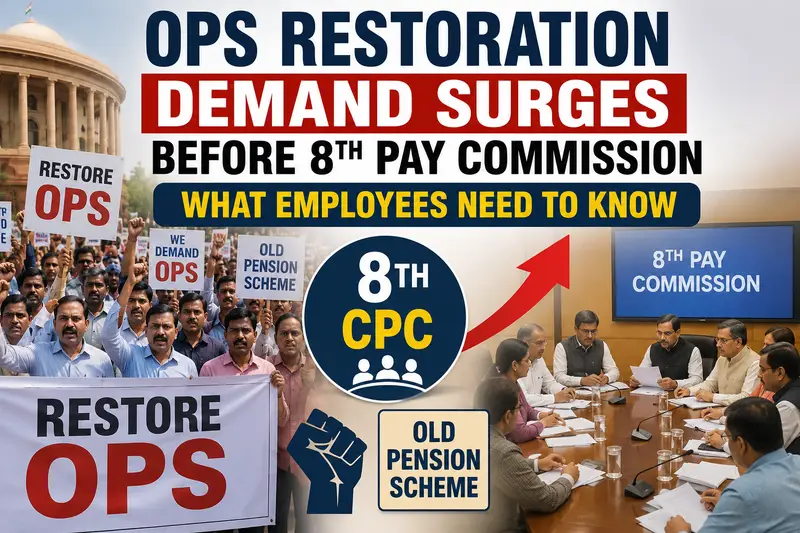
The discussion surrounding the 8th Pay Commission has reignited one of the most contentious issues among government employees in India—the demand for the restoration of the Old Pension Scheme (OPS) in place of the National Pension System (NPS). Employee unions across the country argue that OPS provides guaranteed financial security after retirement, while NPS exposes pensioners to market risks and uncertain returns.
With nearly 1.15 crore government employees and pensioners expected to be impacted by future pay commission recommendations, the debate over OPS and NPS has become a matter of national importance.
Why Has the OPS vs NPS Debate Resurfaced?
The formation of the 8th Pay Commission has given fresh momentum to employee organizations demanding the return of the Old Pension Scheme. OPS vs NPS Debate Many unions believe that the present NPS framework does not provide adequate social security after retirement.
Supporters of OPS argue that pension should be a guaranteed right after decades of public service, whereas NPS links retirement benefits to market performance, making future pension income uncertain.
Understanding the Old Pension Scheme (OPS)
The Old Pension Scheme was applicable to most central and state government employees before 1 January 2004.
Key Features of OPS
- Government-funded pension system.
- Guaranteed monthly pension after retirement.
- Pension generally equal to 50% of the last drawn basic pay.
- Dearness Relief (DR) increases periodically with inflation.
- No contribution required from employees.
- Pension amount remains protected from market fluctuations.
Major Advantage
The biggest attraction of OPS is the assurance of a fixed and predictable income for life, providing financial security to retirees and their families.
Understanding the National Pension System (NPS)
The National Pension System was introduced by the Government of India in 2004 for new central government recruits and was later extended to various sectors.
Key Features of NPS
- Defined contribution pension scheme.
- Both employee and government contribute to the pension fund.
- Pension corpus is invested in financial markets.
- Retirement benefits depend on accumulated corpus and investment returns.
- No guaranteed pension amount.
- Market performance directly influences retirement income.
How NPS Works
Under NPS, contributions are invested through pension fund managers in equity, government securities, and corporate bonds. At retirement, a portion of the accumulated corpus can be withdrawn, while the remaining amount is used to purchase an annuity that provides pension.
OPS vs NPS: Major Differences
| Feature | Old Pension Scheme (OPS) | National Pension System (NPS) |
| Pension Guarantee | Guaranteed | Not Guaranteed |
| Market Risk | No | Yes |
| Employee Contribution | No | Mandatory |
| Pension Amount | Fixed Formula | Depends on Corpus |
| Inflation Protection | Dearness Relief Available | Limited |
| Retirement Security | High | Variable |
| Government Liability | High | Controlled |
Why Are Employee Unions Opposing NPS?
Several employee organizations claim that NPS has failed to provide adequate social security.
Their major concerns include:
1. Uncertain Pension
Unlike OPS, NPS does not guarantee a fixed pension amount. Retirement income depends on market returns and accumulated corpus.
2. Low Pension Cases
Employee associations have highlighted cases where some retirees reportedly receive pension amounts as low as ₹200 to ₹2,000 per month due to insufficient corpus accumulation.
3. Market Dependency
Economic downturns, stock market volatility, and fluctuations in interest rates can significantly affect retirement benefits.
4. Lack of Social Security
Many unions argue that a welfare state should ensure a guaranteed pension to retired public servants.
Why Is It Difficult for the Government to Abolish NPS?
Although employee organizations continue demanding OPS restoration, experts believe replacing NPS entirely would be extremely challenging.
influenced by the commission’s recommendations.
Possible Future Scenarios
Scenario 1: Complete Return to OPS
This remains the primary demand of employee unions but faces significant financial and administrative hurdles.
Scenario 2: Improved NPS
Many experts believe the government may introduce reforms within NPS rather than abandoning it completely.
Possible reforms could include:
- Minimum guaranteed pension.
- Enhanced government contribution.
- Better annuity options.
- Inflation-linked pension protection.
- Improved retirement benefits.
Scenario 3: Hybrid Pension Model
Some policy experts advocate a middle path combining the financial sustainability of NPS with the social security features of OPS.
Impact on Defence Personnel and Pensioners
The recommendations of the 8th Pay Commission will be closely watched by serving defence personnel, veterans, and family pensioners.
Although defence pensioners currently receive pensions under separate provisions, any broader pension policy discussions and pay commission recommendations can have long-term implications for military veterans and future retirees.
Conclusion
The OPS versus NPS debate represents a clash between financial security and fiscal sustainability. Government employees seek the certainty of a guaranteed pension under OPS, while policymakers emphasize the economic advantages of NPS in reducing long-term pension liabilities.
With around 1.15 crore employees and pensioners affected by upcoming decisions, the 8th Pay Commission is expected to play a crucial role in shaping India’s future pension landscape. Whether the government chooses to restore OPS, reform NPS, or introduce a hybrid pension model, the outcome will have lasting conseq
uene for millions of serving employees, retirees, and their families.