
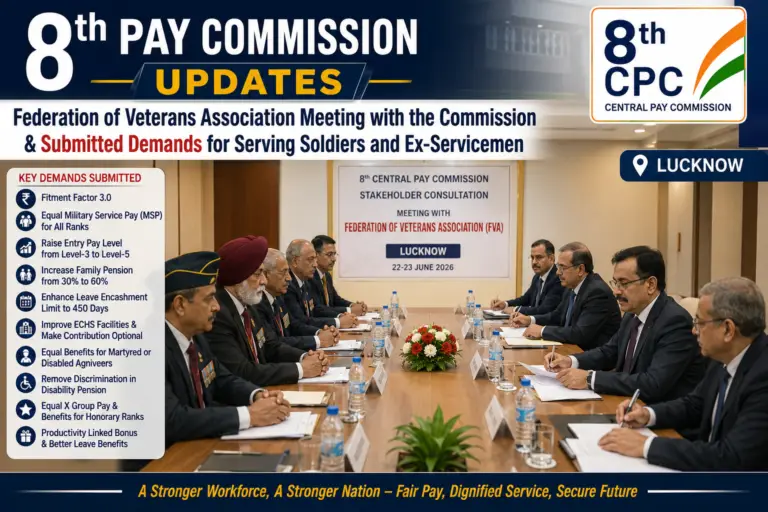
8th Pay : The 8th Central Pay Commission has begun interacting with stakeholders across the country to gather suggestions before preparing its recommendations for the Government of India. In one of the most significant consultations for the defence community, the Federation of Veterans Association (FVA) presented a comprehensive memorandum before the Commission during its meeting in Lucknow.
The memorandum covers a wide range of issues affecting serving Armed Forces personnel, military veterans, widows, disabled soldiers, and Agniveers. The proposals seek improvements in pay, pensions, allowances, healthcare, and service conditions.
Although these are recommendations submitted by the FVA and not decisions of the 8th Pay Commission, they provide valuable insight into the expectations of the ex-servicemen community.
Highlights of the FVA Memorandum to the 8th Pay Commission
The Federation of Veterans Association urged the Commission to address long-standing issues that have affected military personnel over successive Pay Commissions. The major demands include:
- Fitment Factor of 3.0
- Entry Pay Level to begin from Level-5 instead of Level-3
- Uniform Military Service Pay (MSP) for all ranks
- Equal X Group Pay for all eligible personnel
- Restoration of higher pension benefits
- Increase in Family Pension
- Reform of Disability Pension
- Better ECHS facilities
- Enhanced Leave Encashment and LTC
- Equal benefits for martyred and disabled Agniveers
These proposals aim to improve financial security while reducing disparities between different categories of military personnel.
Demand No. 1: Fitment Factor of 3.0
One of the most important recommendations is the adoption of a fitment factor of 3.0 under the 8th Pay Commission.
A higher fitment factor would substantially increase:
- Basic Pay
- Dearness Allowance calculations
- Retirement benefits
- Pension
For serving personnel as well as pensioners, the fitment factor will determine the overall magnitude of salary revision.
Demand No. 2: Raise Entry-Level Pay from Level-3 to Level-5
The FVA has requested that military personnel should begin their service at Pay Level-5 instead of Pay Level-3.
According to the Association, the demanding nature of military service, technical training, and operational responsibilities justify a higher starting pay level.
If accepted, this recommendation would improve:
- Initial salary
- Annual increments
- Promotion benefits
- Retirement pension
Demand No. 3: Equal Military Service Pay (MSP)
Military Service Pay compensates personnel for the unique hardships of military service.
The Association has demanded uniform MSP across all ranks, arguing that every soldier serves under similar operational risks, irrespective of rank.
The objective is to remove perceived disparities within the existing MSP structure.
Demand No. 4: Equal X Group Pay
Technical trades receive X Group Pay because of their specialised skills.
The FVA has requested:
- Equal X Group Pay for all eligible personnel.
- No deduction of technical pay after receiving honorary ranks.
The Association believes that honorary promotions should not reduce financial benefits earned through technical qualifications.
Demand No. 5: Productivity Linked Bonus
Currently, military personnel receive a Non-Productivity Linked Bonus.
The memorandum recommends replacing it with a Productivity Linked Bonus, similar to that available to several categories of Central Government employees.
The proposal seeks greater parity with civilian employees.
Demand No. 6: Increase Leave Encashment to 450 Days
The present leave encashment ceiling is 300 days.
The Federation has proposed increasing this limit to 450 days, enabling personnel to receive greater financial benefits upon retirement.
Since leave encashment forms an important part of retirement planning, this proposal has attracted considerable interest among serving personnel.
Demand No. 7: Better Leave Benefits
The Association has also proposed:
- Increasing Leave Travel Concession (LTC) entitlement from 60 days to 120 days during service.
- Granting one additional month of annual leave to personnel serving in Counter Insurgency (CI) areas.
The objective is to improve work-life balance and recognise the hardships of operational deployments.
Demand No. 8: Restore Higher Service Pension
The memorandum recommends increasing service pension to 67% of the last emoluments.
The Association noted that soldiers received pension at around 70% of last pay prior to the 3rd Pay Commission, and it believes pension levels should be improved to better reflect the nature of military service.
Demand No. 9: Increase Family Pension
One of the most significant social security proposals is increasing the Family Pension from 30% to 60%.
If accepted, this would substantially improve financial support for widows and dependent family members of deceased personnel.
Demand No. 10: Remove Discrimination in Disability Pension
The Federation has requested the Commission to eliminate disparities in disability pension provisions.
According to the Association, compensation should adequately recognise disabilities sustained during military service and ensure fair treatment for all disabled veterans.
Demand No. 11: Monetary Benefits for Honorary Ranks
The memorandum also recommends extending monetary benefits to all honorary ranks.
Currently, certain honorary promotions receive limited financial recognition.
The Association argues that every honorary promotion should carry corresponding monetary benefits after retirement.
Demand No. 12: Reforms in ECHS
Healthcare remains one of the major concerns of veterans.
The Federation has proposed:
- Making ECHS contribution optional.
- Equal ward facilities for all ranks.
- Uniform treatment standards throughout the ECHS system.
According to the memorandum, equal medical allowance should be accompanied by equal healthcare facilities.
Demand No. 13: Equal Benefits for Agniveers
The Association has strongly recommended that martyred or disabled Agniveers should receive the same facilities and financial benefits available to regular soldiers.
The proposal focuses on ensuring parity in welfare and compensation for those who make the ultimate sacrifice or suffer disability during service.
Significance of the Lucknow Meeting
The meeting between the Federation of Veterans Association and the 8th Pay Commission panel lasted approximately 45–50 minutes.
Representatives stated that the interaction took place in a constructive atmosphere, allowing them to present their demands point by point. The consultation forms part of the Commission’s nationwide exercise to gather views from stakeholders before finalising its recommendations.
Such interactions are important because they allow serving personnel, veterans, employee organisations, and other stakeholders to place their concerns directly before the Commission during the consultation phase.
What fitment factor has the Federation of Veterans Association demanded?
The Association has recommended a fitment factor of 3.0.
What is the proposed change in military pension?
The memorandum recommends increasing service pension to 67% of the last emoluments and raising the family pension to 60%.
What changes have been proposed for ECHS?
The proposals include optional ECHS contributions, equal ward facilities across all ranks, and improved medical benefits.
What benefits has the FVA demanded for Agniveers?
The Association has requested that martyred or disabled Agniveers receive welfare benefits and compensation comparable to those available to regular soldiers.
Conclusion
The Federation of Veterans Association has presented one of the most comprehensive memorandums before the 8th Pay Commission, covering pay revision, pensions, allowances, healthcare, leave benefits, and welfare measures for serving soldiers, veterans, and their families.
Whether these proposals become part of the final 8th Pay Commission recommendations will depend on the Commission’s evaluation and the Government’s subsequent decisions. Nevertheless, the memorandum reflects the key priorities of the veterans’ community and is likely to remain an important part of the ongoing discussions on defence pay and pension reforms.