
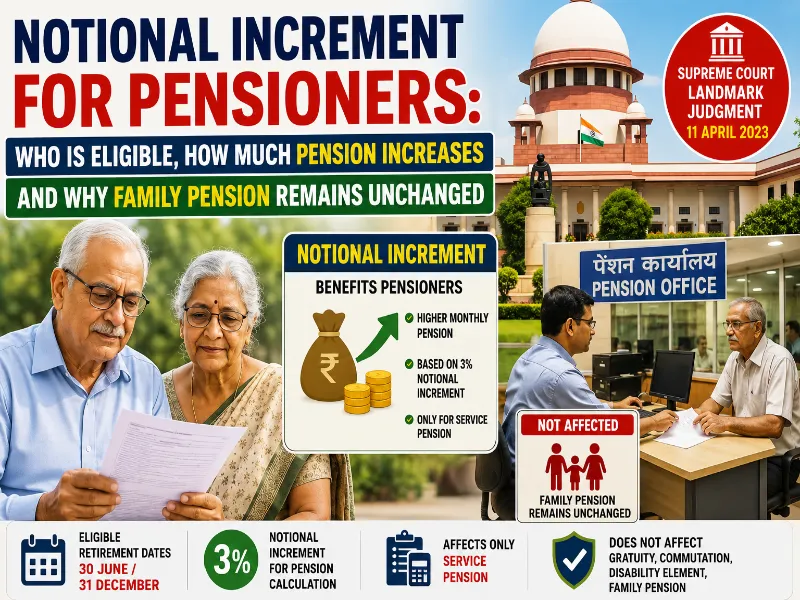
For years, thousands of retired government employees who completed a full year of service but retired just a day before their annual increment date felt they had been denied a benefit they had effectively earned. That long-running dispute led to one of the most significant pension-related developments in recent years. The concept of a notional increment has now become a widely discussed topic among pensioners, especially those who retired on June 30 or December 31. While the ruling has opened the door to higher pension calculations for many retirees, it has also raised questions about eligibility, the actual financial benefit, and why family pension remains outside its scope.
What Is a Notional Increment and Why Did It Become a Major Issue?
Government employees earn annual increments after completing a prescribed period of service, typically one year. The controversy emerged because some employees retired one day before the increment became formally due. Although they had completed the required service period, they were not granted the increment since they were not in service on the increment date.
Many retirees challenged this interpretation, arguing that the increment was earned through completed service and should be considered while calculating retirement benefits. Courts across the country examined the issue, leading to a series of judgments that eventually brought national attention to the matter.
The notional increment does not mean payment of salary after retirement. Instead, it is treated as an increment added notionally for the limited purpose of recalculating pensionary benefits.
Who Is Eligible for the Benefit?
Eligibility remains the most important aspect of the issue. The benefit primarily applies to employees who completed a full year of qualifying service and retired immediately before their increment date.
In most cases, the discussion centers around employees who retired on:
- June 30 before the July 1 increment date
- December 31 before the January 1 increment date
The principle behind eligibility is straightforward. If an employee successfully completed the service period required to earn the increment, the benefit may be considered for pension calculation purposes even though the employee retired before the increment was formally credited.
However, implementation can vary depending on service rules, department-specific orders, and administrative instructions issued after court decisions. Pensioners are therefore advised to verify their individual eligibility through the concerned department.
How Much Can the Pension Increase?
The financial impact differs from case to case because pension calculations depend on an employee’s pay level at the time of retirement. In many cases, the notional increment amounts to a 3 percent increase in basic pay before pension is calculated.
Once the revised basic pay is taken into account, the pension is recalculated accordingly. While the increase may appear modest on paper, it can lead to a meaningful rise in monthly pension over time, particularly when combined with future dearness relief revisions.
| Pension Factor | Impact |
|---|---|
| Notional Increment | Usually 3% of basic pay |
| Service Pension | May increase after revision |
| Family Pension | No change due to increment |
For many retired employees, even a small monthly increase becomes significant over the course of several years, especially considering rising healthcare and living expenses.
Why Family Pension Is Not Affected
One of the most common misunderstandings among pensioners relates to family pension. Many beneficiaries assume that if a service pension increases because of a notional increment, the family pension will automatically rise as well.
That is generally not the case.
Family pension operates under a separate set of rules and calculations. The purpose of granting a notional increment is to address the service-related entitlement of the employee who completed the qualifying period before retirement. Since family pension is governed by different provisions, the benefit of the notional increment is usually restricted to service pension calculations.
This distinction has been clarified repeatedly in discussions surrounding the issue. As a result, while eligible retirees may see a revision in their own pension, the family pension component generally remains unchanged.
What the Ruling Means for Retired Employees
The broader significance of the notional increment debate goes beyond the financial benefit itself. Many pensioners view it as recognition of completed service and a matter of fairness rather than merely a pension enhancement.
Retirees who spent decades in government service often argued that denying the increment despite completion of the required service period created an artificial distinction based solely on the retirement date. The legal recognition of this argument has been welcomed by many employee associations and pensioner groups.
The issue has also highlighted the growing importance of pension rights and retirement-related litigation in India, where millions of government employees depend on pension benefits for financial security after retirement.
What Pensioners Should Do Next
Retired employees who believe they fall within the eligible category should carefully review their retirement date, service records, and applicable departmental instructions. Since implementation procedures may differ across departments and organizations, understanding the specific rules applicable to their service becomes essential.
Pensioners should also keep copies of pension payment orders, retirement documents, and pay records readily available if any recalculation process is initiated. Proper documentation can help ensure that eligible claims are processed smoothly.
As awareness about the notional increment continues to grow, many retirees are revisiting their pension calculations to determine whether they may be entitled to revised benefits under the evolving legal and administrative framework.
FAQ
What is a notional increment for pensioners?
A notional increment is an increment considered for pension calculation purposes when an employee completed the required service period but retired before the formal increment date.
Which retirees are generally eligible for the benefit?
Employees who retired on June 30 or December 31 after completing the required qualifying service are among the most commonly discussed categories for eligibility.
Does the notional increment increase family pension?
No. The benefit is generally linked to service pension calculations and does not normally result in an increase in family pension.