
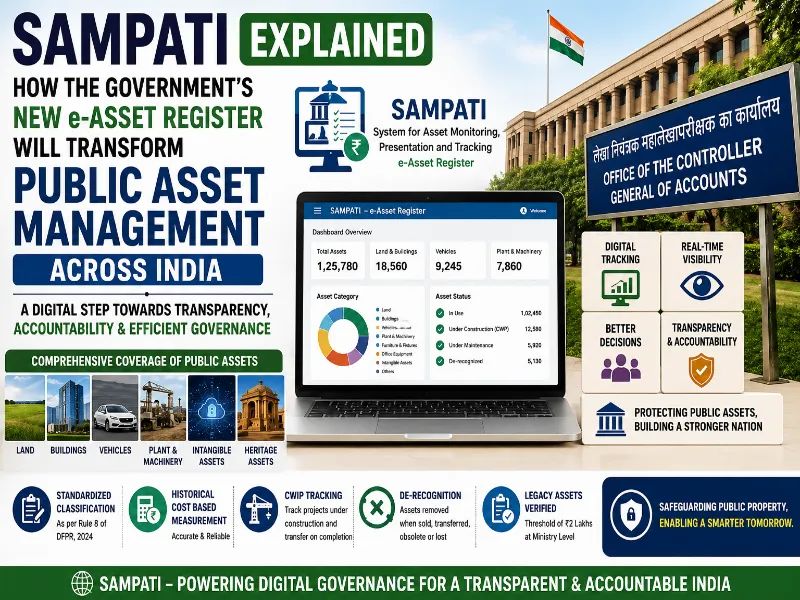
The Government of India has taken a significant step toward modernizing public asset management with the launch of SAMPATI, a new digital e-Asset Register designed to bring greater transparency, accountability, and efficiency to government-owned properties and infrastructure. For decades, government departments maintained records of land, buildings, vehicles, machinery, and other assets through separate systems, often making monitoring and verification a complex exercise. SAMPATI aims to change that by creating a centralized digital platform capable of tracking public assets throughout their lifecycle.
The initiative arrives at a time when governments worldwide are embracing technology-driven governance to improve decision-making and strengthen public trust. By creating a structured digital inventory of assets, authorities hope to gain a clearer understanding of what the government owns, how those assets are being utilized, and where improvements are needed.
What Is SAMPATI and Why Was It Introduced?
SAMPATI stands for System for Asset Monitoring, Presentation and Tracking. The platform has been developed to create a comprehensive electronic register of government assets and provide real-time visibility into their status.
Managing public assets across multiple ministries, departments, and agencies has traditionally been challenging. Different organizations often maintained separate records, making consolidation difficult. In some cases, outdated information or incomplete documentation created hurdles in financial reporting and asset verification.
SAMPATI seeks to address these challenges by providing a standardized framework for recording, classifying, monitoring, and updating government-owned assets. The objective is not only to improve record-keeping but also to support better governance and more informed policy decisions.
What Types of Assets Will Be Covered?
One of the most important features of the platform is its broad coverage. SAMPATI is designed to capture a wide variety of public assets that are currently spread across different departments and administrative systems.
The platform can include records related to:
- Land holdings
- Government buildings
- Vehicles
- Plant and machinery
- Infrastructure projects
- Heritage assets
- Intangible assets where applicable
This comprehensive approach allows departments to maintain a clearer picture of their resources and responsibilities. A centralized database can also reduce duplication and improve coordination between agencies.
| Asset Category | Purpose |
|---|---|
| Land & Buildings | Property ownership and management |
| Vehicles & Machinery | Operational asset tracking |
| Infrastructure Assets | Monitoring and lifecycle management |
How the Digital Register Can Improve Transparency
Transparency remains one of the strongest arguments in favor of digital asset management. Public assets represent significant investments funded by taxpayers, making accurate record-keeping essential.
A digital register enables authorities to verify ownership, monitor asset conditions, and maintain updated records in a structured format. It can also help identify underutilized assets, assets requiring maintenance, or assets that may no longer serve their intended purpose.
Officials responsible for governance and financial management can access more reliable information when preparing reports, evaluating budgets, or making investment decisions. This level of visibility can contribute to stronger accountability throughout the public sector.
The move is particularly relevant as governments increasingly focus on data-driven administration and evidence-based policymaking.
Better Decision-Making Through Real-Time Information
One of the biggest limitations of traditional asset registers is the delay in obtaining accurate information. Manual processes often require extensive verification and coordination between multiple offices.
SAMPATI aims to provide near real-time visibility into asset status and movement. Decision-makers can potentially access updated information regarding asset utilization, maintenance requirements, project progress, and operational readiness.
For example, if a ministry wants to assess the availability of certain infrastructure assets or review ongoing capital projects, the information can be consolidated within a single system. This reduces administrative delays and supports faster decision-making.
The platform may also help improve long-term planning by providing historical records and asset performance data that can guide future investments and maintenance strategies.
Why Asset Verification Matters for Public Finance
Public asset management is closely linked to government finances. Accurate asset records help improve budgeting, auditing, financial reporting, and resource allocation.
When departments possess reliable information about their assets, they can make better decisions regarding maintenance, upgrades, disposal, and replacement. This can lead to more efficient use of public funds and reduced wastage.
SAMPATI also supports efforts to strengthen compliance with modern financial management practices. Standardized asset classification and digital documentation can improve consistency across departments and enhance the quality of government financial records.
As public infrastructure continues to expand across India, maintaining an accurate and verifiable inventory becomes increasingly important for both governance and fiscal responsibility.
What SAMPATI Could Mean for the Future of Governance
The launch of SAMPATI reflects a broader shift toward digital governance and smarter public administration. Technology is increasingly being used to improve service delivery, strengthen oversight, and create more transparent systems.
A centralized e-Asset Register has the potential to transform how government property is monitored and managed. Instead of relying on fragmented records and manual reporting, authorities can work with a unified platform that provides greater visibility and control.
For citizens, the initiative represents another step toward accountable governance. For administrators, it offers a modern tool capable of supporting more efficient management of valuable public resources. As adoption expands across departments, SAMPATI could become one of the most important building blocks in India’s evolving digital governance framework.
FAQ
What is SAMPATI?
SAMPATI stands for System for Asset Monitoring, Presentation and Tracking. It is a digital e-Asset Register designed to record and monitor government-owned assets.
What types of assets are included in SAMPATI?
The platform can cover land, buildings, vehicles, machinery, infrastructure assets, heritage assets, and other government-owned resources.
How will SAMPATI benefit public administration?
It improves transparency, strengthens asset tracking, supports better decision-making, enhances financial management, and helps maintain accurate records of public assets.